


 60 / 68

60 – Purebred PIGEON
O
lde
S
tyle
S
addle
T
umblers
–
M
y
B
reed
O
f
C
hoice
By Barry Wilson – Round Rock, Texas
I have kept pigeons since childhood when my neighbor gave me
a pair of rollers. From that point forward I was hooked on pigeons.
I eventually moved on to other breeds settling on LF Muff Tum-
blers for many years. I lived in the upper midwest which made it
a challenge to breed and keep healthy these increasingly difficult
to raise Tumblers. At some point in the 1980’s I found and added
the Olde Style Saddle Tumblers. Upon moving to central Texas I
had high hopes for better breeding success with the muff Tumblers
and improving my stud of saddle Tumblers. After my first breeding
season and banding 130 youngsters my loft was infected with Circo
young bird virus. Every single youngster died as they turned five
months old, plus a few adults. The next year I had a short season with
old birds that survived and all seemed well. The following season
someone sent me a bird with Adeno virus which wiped out the Muff
Tumblers and a couple breeding projects. I was at least able to stop
the virus with the ‘Adeno Plus’ product but still lost most of my birds.
Now 13 years later my birds are healthy and thriving.
My primary breeds now are the Olde Style Saddle Tumblers
and muffed Chinese Owls. A few other breeds are kept just for fun. I
have always found that breeds with a lot of white in the pattern, as
with the Saddles, hold a strong attraction for me. This breed is lively
without being aggressive and makes good parents. This is a breed
that we want to keep as “Old Style” with medium-length beaks, me-
dium small size, and good parenting skills. So many breeds increase
in size over the years as well as become more difficult to raise but
this is not a goal for this breed.
Here in the Deep South I begin the breeding season in De-
cember and end in early May, which usually gives me four rounds.
Then they are separated for our long very hot summer. I do not like
to stress my birds in any way, which I believe is key to keeping them
healthy. Cocks and hens are given free flight on alternating days in
summer until the hawks migrate down in fall. Giving them free flight
helps them burn off energy and keep them in good form. They do fly
and occasionally flip once or twice but they do not kit well. I have
tried letting my Ruby Rollers raise them and then train them with
young Rollers but they do not have the endurance or ability to fly like
Rollers. The cocks, when given free flight, are especially active and
love to show off clapping wings as they fly in large circles, each bird
going in a different direction.
Because of our hot dry summer conditions the birds seldom
have body mites or worms. Droppings dry up quickly and birds gener-
ally stay healthy. We do have pigeon flies, lice and in wetter spots Pox
can be a problem but has not been for me. I prefer to cage breed my
saddles and this arrangement works very well for breeding. I usually
breed from 30 pair, many of which are color projects. At one time
I had 15 colors and continue to work on more. Achieving the face
markings on new colors is a ongoing project requiring good record
keeping. It’s easy to become frustrated and end up with too many
birds that are still not close to what you want. However I enjoy my
projects and never give up hope.
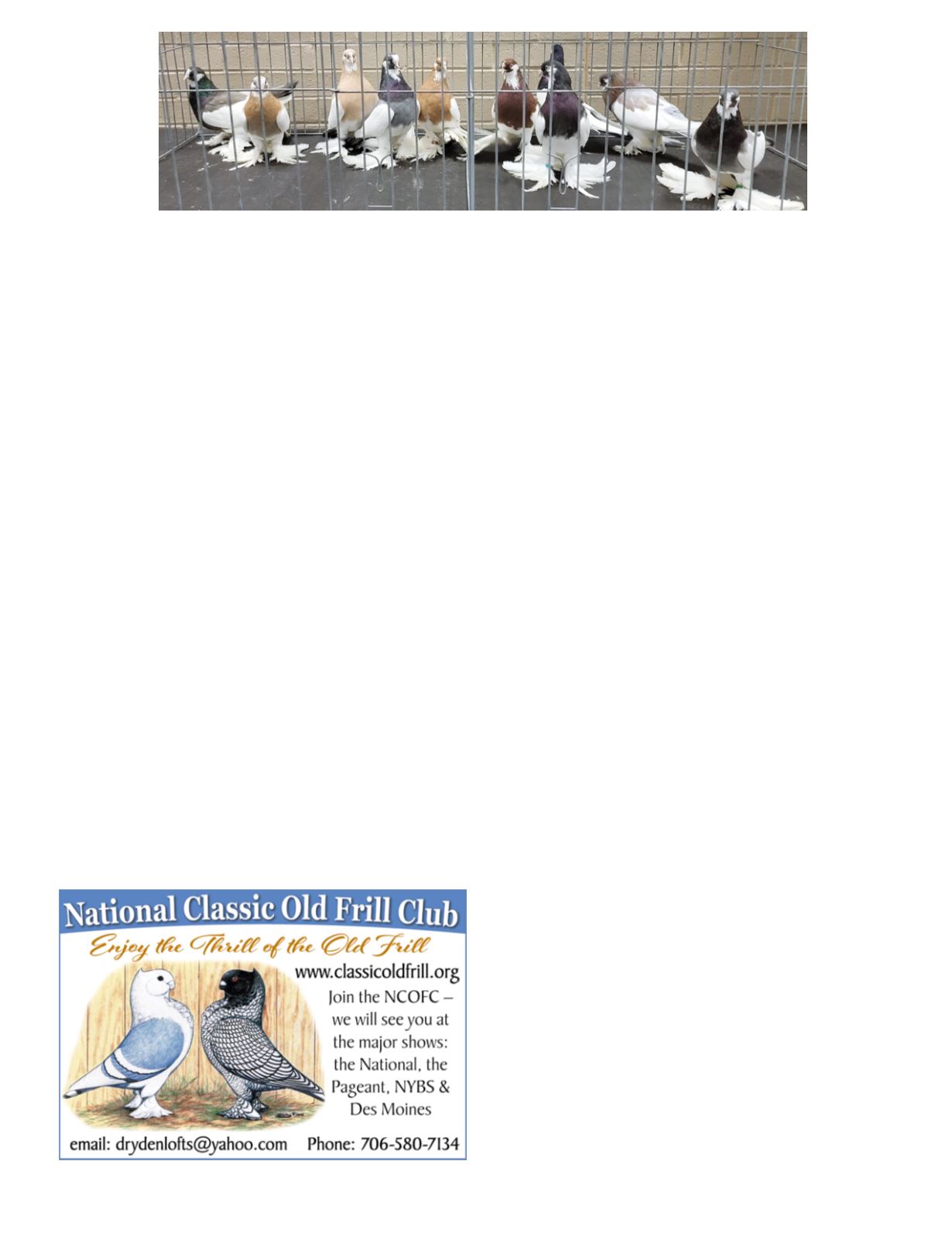
The primary focus of this breed are the markings. The saddle
pattern itself should have clean margins separating the white from
the color. The head is the real challenge. It should contain a forehead
snip of white, a white dot above each eye and a bib connecting side
to side with a colored cheek area on each side. The rump and hocks
must also be white and muffs should be at least 4” long. I have found
that getting all these features and more to standardize in a bloodline
is a huge ongoing challenge. It seems some colors are easier (black,
red, yellow) than others to abstain the best markings. Most of my
breeders are stock birds which produce show quality. Some pairs
also ‘click’ better than others at producing really well marked birds. I
make the first cull at banding time when I can clearly see mismarks.
Once a youngster is weaned I keep them until the final molt as I have
learned that they often improve with face markings as they mature.
This is a challenging but rewarding breed to raise. If interested,
join our club of friendly helpful breeders and look for this breed at
the shows. •
(see our ad in the classified section of this issue)