


 62 / 68

62 – Purebred PIGEON
IranianHighFlyers+Tipplers=
ChampionFlyers
By Hamid Zia - Toronto, Canada
Hot summer days and hot pigeon flying
competitions are two inevitable parts of
pigeoning in Iran. Every year between June
22nd to July 22nd thousands of fanciers
compete in a traditional match has been held
between two fanciers at a time, called “Ge-
row.” In a Gerow, competitors fly anywhere
between 21 to 1500 pigeons, usually on the
same day. Whoever has the higher average
time is pronounced the winner. Because these
fanciers are not competing in a league of any
sort, unfortunately we don’t know officially
who gains the best time.
But Mr. Sirus Chenari, 68 years old, has
a different story. Back in the 1990s in Europe,
where he flew birds, Mr. Chenari placed World
Champion titles several times. In the years
1993, 1997, and 1999 he managed to win the
first place for both young and adult and
longest day. 1993 was the year that he was
announced the “General Champion,” due
to several first places and also the most
number of birds in each kit (11& 8). In 1997,
Chenari took his chances and performed an unorthodox move. He
flew three young birds for the longest day competition (19:23h) and
he used the same young birds for young bird competition(19:01h). In
1999 he repeated the same unorthodox move and registered 19:38h
for the longest day and 19:12h for the young birds’ competitions.
A few years later he returned to his hometown of Babol, Iran.
where he worked on his bloodline. According to him, his bloodline
contains Iranian Highflyer, English Tippler, German Tippler, Belgian
Tippler and some other high and low flyers. His main purpose was to
create a strain that could fly in a large kit
for several hours. Once he flew 51 pigeons,
but couldn’t succeed as he expected. Once
he flew five birds in order to set a new
record but unfortunately one bird got dis-
qualified by going over the night.
On May 12th, 2022 he tried with 11
birds, for a different purpose. In Iran, com-
petitors love to fly great numbers of birds.
This reduces their average, and lowers the
hours way below the ones recorded inter-
nationally. For example, the best average
for 300 birds is 6 hours or so. It has become a tradition that quantity
is preferred to quality, to the point that some fly 1200 to 2000 birds
in a competition. When Mr. Chenari agreed to fly 11 birds for 14
hours straight, a lot of fanciers made fun of him. But at the end of
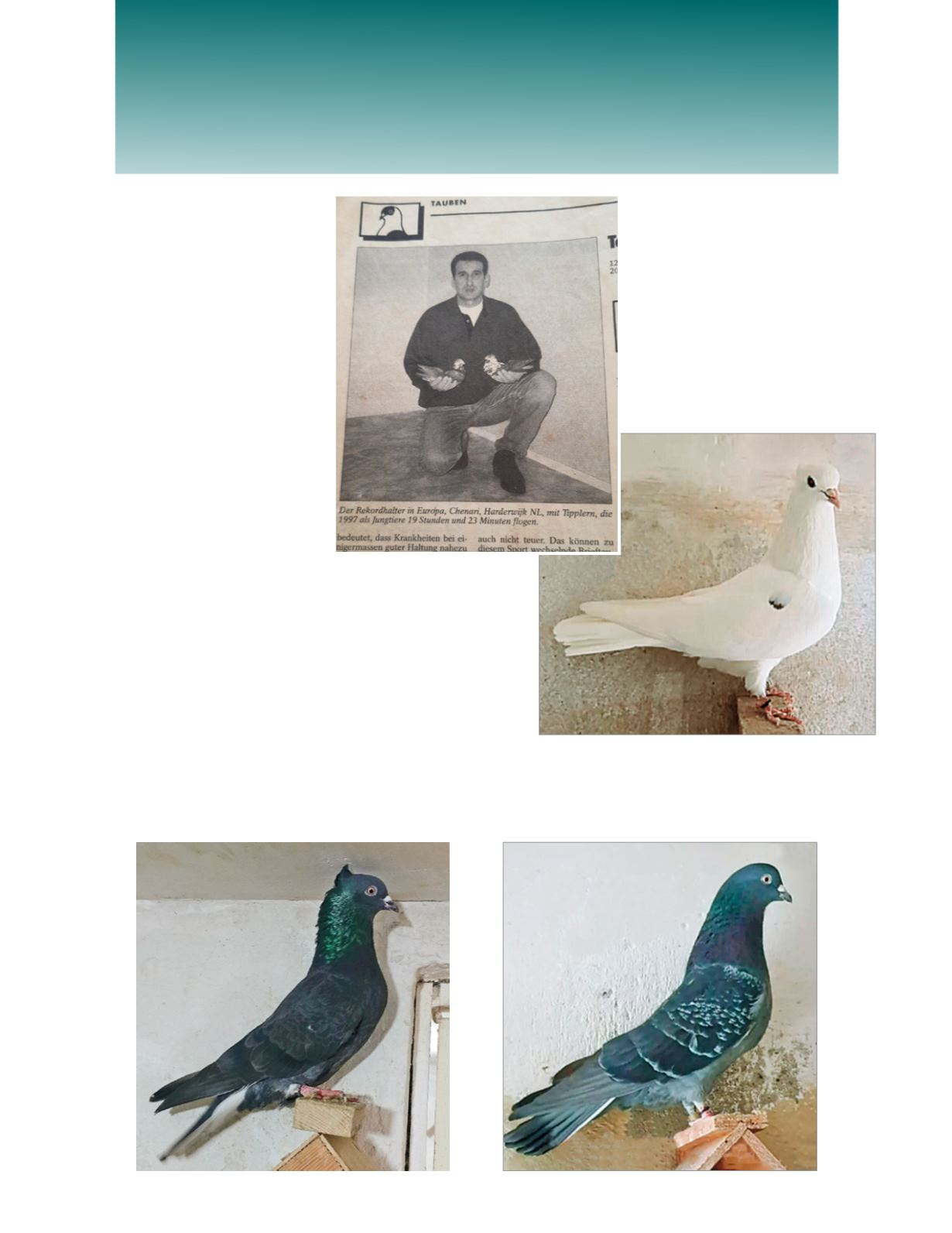
Sirus Chenari pictured in a
European Pigeon newspaper for
his flight of 19 hours and
23 minutes