


 18 / 68

18 – Purebred PIGEON
to mend old wounds.
Sorry for being so long
winded but basically this is the
truth of the Trentons. They are
a slow maturing bird and not
a bird for the handler that is
looking for quick results. Every
now and then you will get a
youngster that totally stands
out, but for the most part
they are their best as three
years old or older. We won a
500-mile race in Lisbon, Ohio
with a nine-year-old cock.
At one time the old-bird 500
milers were revered and gave
you bragging rights for a good
bit of time. Those were the
days when weather predic-
tions were as reputable as our
politics of today. Birds would have to fly though rain, snow, and wind.
Truly the days of the Trentons! Somewhat different than the highly
prized and desired young-bird money races of today. Why invest time
with birds that are not bred to compete in fair weather young-bird
race? Could be you may have a smash race and the slow and steady
Trenton still comes through, many a handler has benefited from the
Trentons on maintaining their average speed.
Since I am rambling, which I have been known to do, I will tell
you of an incident that happened years ago. I was at a combine dinner
at a club on the East Coast of Florida. It was the night before their
300-mile band race. My friend Jay Holder introduced me as the son of
Ed Oshaben. Later that evening, I was approached by one of the club
members and he told me he had purchased four Oshaben Trenton’s
and was not at all impressed with them. I asked him what the problem
was, and he stated he bought the birds because his wife wanted some
color added to his flock. Two of the birds were Red Mottles and were
some of the first to be picked off by the hawks – which is a true state-
ment. When you have a flock of all uniformed colored birds, hawks
will go after the odd bird out. I asked about the other two and he
stated he rang their necks because as young birds they were not worth
keeping. Not all handlers take the time and have the determination
to harvest the rewards from a bird’s full potential, those that do make
a name for themselves and their birds. To the respect of the gentle-
man I met that evening, he had the right to handle his birds his own
way. I did not catch his name and honestly, I am sure he will remain
unknown!
Basically, the point that I am trying to make with my stories are
that so many people judge the Trenton strain before the birds have
time to prove themselves. We have all heard that to be successful at
racing pigeons, it comes down to Birds, Location and Handler. I have a
friend who flew the Philadelphia area many years ago. He was shy one
homer hen, so he allowed his homer cock-bird to pair up with a roller,
mainly just to keep peace in the loft. For the heck of it he banded a
pair of youngsters and would train them out with his young bird team.
One youngster never made
it past 50 miles. The other,
which was a petite little hen,
ended up winning two 100
miles races and one 200-mile
race. So, back to the three
factors of successful racing.
Birds, Location and Handler.
In my opinion, that proves
that the Handler is the
MOST important factor in
that equation.
With all this rambling
that is flying from my typi-
cally ignored keyboard about
pigeon stories and my years
with Oshaben Trentons,
I will say I am extremely
proud of my Dad’s birds.
They are amazing represen-
tatives of a True Trenton. Still, they are not without fault. Probably
the number one problem would be, to be successful, they need to be
in the loft of a seasoned and knowledgeable handler that will take the
time to allow them to be what they were bred for.
For all those years my Dad maintained not only the same strain
but the same bloodline of this remarkable family of birds. The blood/
bloodline of the birds I still maintain can be traced back to the same
birds he kept as a young boy. Unlike most young men and their pigeons
my Dad never had a break from his birds. He did not abandon them
during his late teens or even later with the marriage of my Mother
and raising six kids. The closest he came was when he tried to enlist
during WW2, but due to a lifelong effect from an eye injury he received
as a young child he was not eligible for service. Instead, he had his loft
certified with the military so he could donate birds to the effort.
I am very proud to report that my Dad was the 2021 recipient for
the A.U. Breeder Elite award honoring him for his unique abilities and
dedication to the Racing Pigeon Sport and his many decades with his
Oshaben Trentons.
Throughout my life I have found myself arguing and defending
the existence of a pure Trenton but, through the years and the bore-
dom of battling detractors and critics, I have decided to just let them
foolishly ramble on. For me, all I need to do is walk into my loft every
day and know they exist!
After my Dad’s passing, we heard from pigeon guys all over
the world. I was surprised to hear from enthusiasts in Australia that
referred to my Dad as the “
keeper of the strain
”. In fact, they did a
story about my Dad and featured his birds in a 2005
Australian Racing
Pigeon Journal
as well as one in the
British Homing World
magazine.
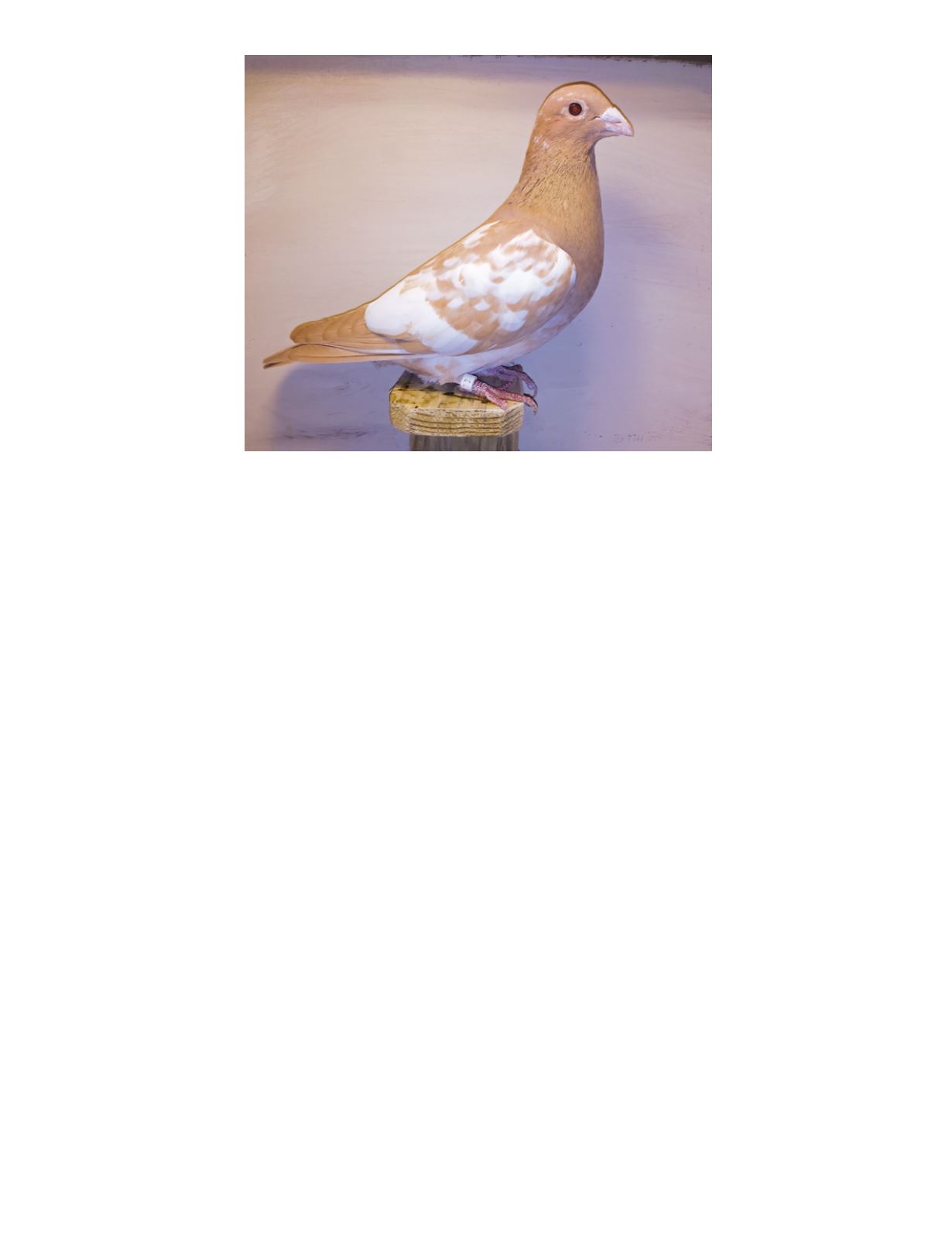
There are so many factors that make up a Trenton. Unfortu-
nately, to some it means a yellow pigeon!!! Wrong. Color can be a
factor but mostly it is in the bird’s body confirmation. They have a
long cast deep keeled body, long wing, broad flights with a noticeable
step in-between the primary and secondary flights. A pearl eye with
a pronounced eye cere and healthy wattle as well as an amber beak.