


 16 / 68

16 – Purebred PIGEON
By Chuck Oshaben
I
never remember not having pigeons in my life. My Dad told me at age
four, I could hand feed a youngster as well as any pair of birds. A good bit
of my childhood was spent either in the coops, watching the birds exercise,
spending Friday at shipping night or – of course, waiting on race day. May
sound crazy, but I loved helping maintain our birds. Breeding season was a
major event for me each year. Seemed like it would take a month for those first
rounds of eggs to hatch.
By the way, my name is Chuck Oshaben and my Dad was Ed Oshaben.
My Dad was a collector of strains. In Cleveland, each of his breeder
lofts would house one family of birds only. I can still picture his Hansenne
section. Some almost powder blue in color, some splashes and all beautiful.
With tight feather, shortened beaks and some still sporting a frill. A true
breeder of perfection.
I remember in the 1960s my dad returned from the airport with a
wooden crate full of Huysken Van Riels from
Dr. Whitney. Half of the White City Homing
Club membership showed up to see them.
Fooling with Sions during that time, he had
the old Foster’s, which I tried to locate later in
life with no luck and he also had his Bastins
to name a few. But my Dads focus were his
Trentons.
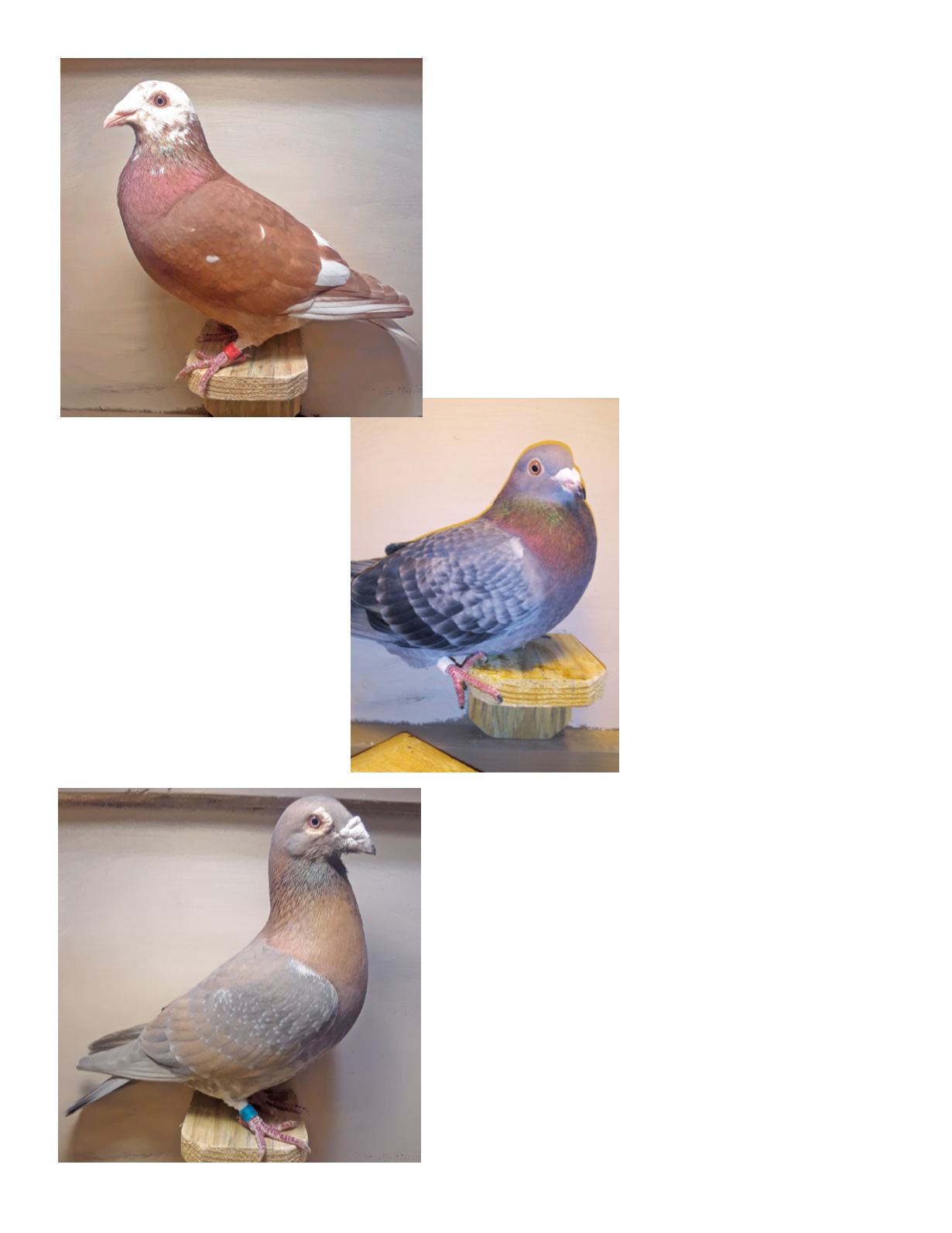
The Trentons are the First American
Strain, sometimes called the Bright Eye
Strain or also the Old Waxbills. They were
developed back in 1886 by Conrad Mahr by
crossing the Offerman strain, which were
handled by an Irish flyer named McCluthian,
to birds from Henri Soffle. The McCluthian
birds were descendants from the old ship
birds that were used even back to the 1850s.
These birds were tasked to deliver estimated
arrival times and news from sailing cargo
ships, basically as a dependable form of ship
to shore communication. They were required to travel distances though
rough weather and open waters. Which should tell you that these birds were
bred with a high degree of endurance excellence.
The success of the young Conrad Mahr and his newly developed Tren-
tons rapidly exploded! In fact, in his early days he received much grief and
ridicule from the older and more established club members of the time. His
birds were constantly in the winner circle and were responsible for estab-
lishing such records as the FIRST 500-mile day bird, 600 mile day bird, 700
mile day bird and were the birds that repeatedly excelled in the 1,000 mile
races, some completing over 1,300 plus miles in record time. The mating of
the cock-bird known as
Trenton 137
to his niece
Bright Eye
were responsible
for producing over twenty-five 500-mile day-birds alone.
Besides developing an incredible strain of record winning pigeons,
Conrad was able to totally comprehend the importance of giving his birds
yet one more reason to return home, and that was by creating a love-of-loft
atmosphere in his coops. He truly was a knowledgeable handler and well
ahead of his time. Thanks to his Trentons, Conrad’s reputation grew like
wildfire and solidified his name in Pigeon History.
Growing
up
Trenton