


 28 / 68

West of England Tumblers – Page 28 – Purebred PIGEON
Breed of the Issue - West of England Tumblers
Baldheads andShieldMottles inWests
By John Kieft - NWOETC District 5 Director
L
ike many pigeon fanciers, I have had many breeds over
the years, but I have mainly focused on West of England
Tumblers. I got my first start in red and yellow baldheads in
1957 (I was twelve), from a renowned West breeder, Ralph Aldridge,
of Porterville, California. And, over the years, I have raised baldheads
in black, dun, brown, khaki, Andalusian, red, yellow, and opal. Except
for my Navy years on a destroyer, I have had them continuously ever
since. So, I’d like to share with you a few of the things I’ve learned
about baldhead markings, and also shield mottle markings.
Baldheads in Wests which is the piebald genetic factor, has
three primary areas of concern. The white of the head and bib, the
flights and secondaries, and the hocks.
In the head and neck, the standard calls for the white at the
back of the head to end at a point where a line drawn through the
beak and under the edge of the eye, meets at the back of the neck.
Here the challenge is keeping that line high enough and avoiding
what we call the “sockhead” look. There’s an old saying that says
“white spreads,” and so birds that are “down in back” are mostly
culled, because regardless of the bird’s other great attributes, that
line is not coming back up in their young, and so you potentially
doom your breeding project.
Now as for the the bib on the baldhead marking. Here, the
white of the bib is to end approximately 1/2 inch below where
the beak would touch if the head were bent down. It is also to be
V-shaped. Here again, the old saying is true, and we must cull for
long bibs as they are not coming back up in their offspring.
In wing markings, the same thing holds, the standard calls for
white flights and colored secondaries, so allowing white to spread
into the secondaries is not a wise practice. White in just the first
secondary can still work, but two or more rarely does. Another
thing to keep in mind are the thumb feathers, the four or five small
feathers at the wing butt, where the primaries and secondaries di-
vide. They should also be colored, but white likes to spread here as
well, and once white, they are very hard to get colored again, and
show prominently on the wing butts when the bird is stationing.
This distracts from the overall look of solid color. Thankfully there
are many variations in inheritance, and occasionally we might
get lucky and breed a white hocked bird, that’s under marked on
flights, but has colored thumb feathers. Maybe a 9 x 9 primary
count. While maybe not the best show bird, these are gold in the
breeding program, making excellent stock birds.
Hocks are the next area of concern. For many years, colored
hocks were the norm until the standard changed to require white
hocks. Here, the “white spreads” has worked in our favor, but for
many years we all had to keep birds that were split hocked (one
white, one colored), that were purely stock birds and pathways to
the ultimate goal.
So, as you can see, it’s hard to breed perfectly marked birds
with good bibs, 10 x 10 primaries with colored thumb feathers
and white hocks. But, we have all bred a few and some have been
outstanding show birds. Some of them however, wind up lacking in
some other feature such as good color, good head shape or station.
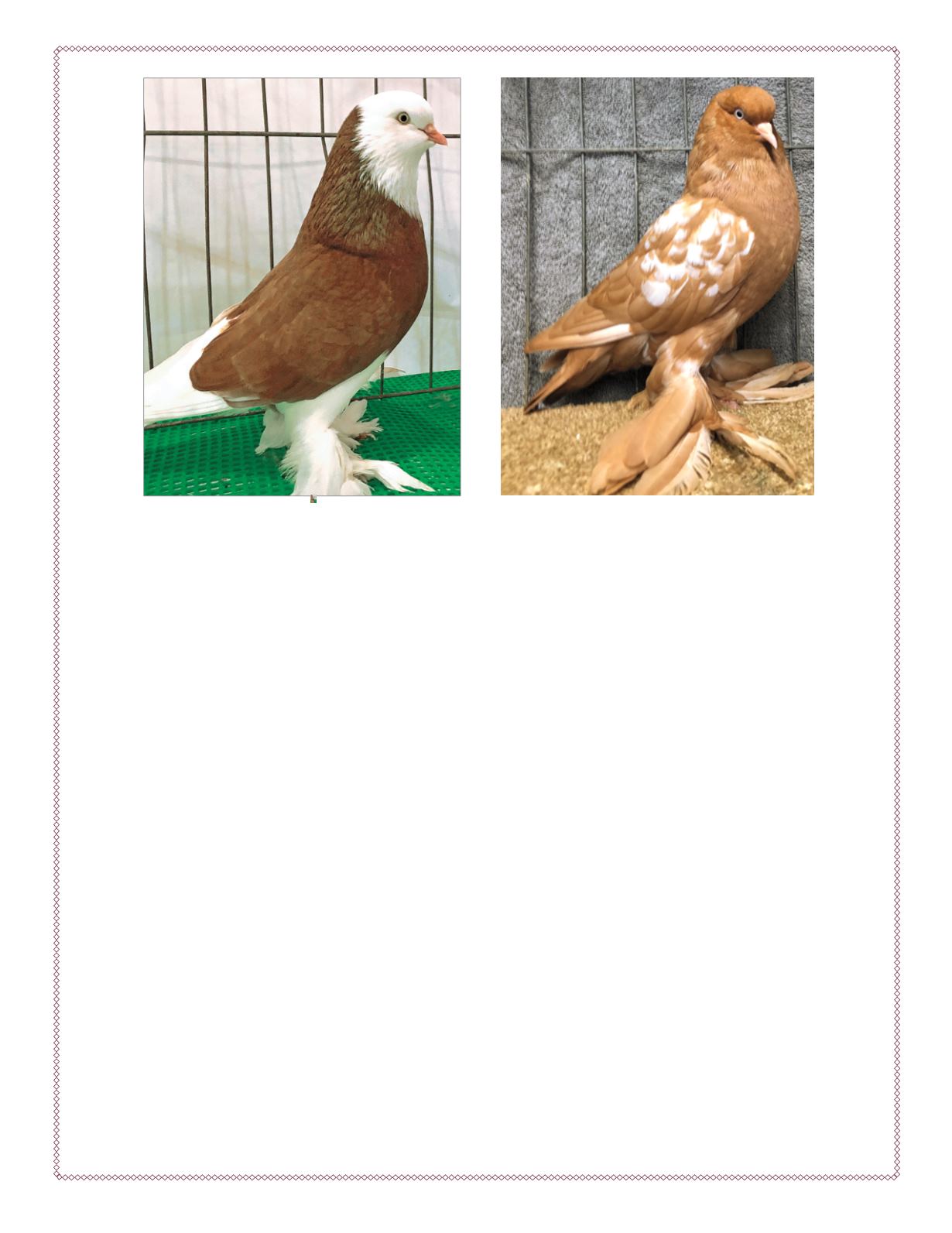
Red Baldhead
Yellow Shield Mottle