


 46 / 69

Helmet – Page 46 – Purebred PIGEON
Breed of the Issue - Helmet
of Genetic Sources in the Netherlands (CGN)
connected with the world famous Wageningen
University and Research (WUR) so that the
genetic material can be stored in the national gene
bank for agricultural animals for the protection of
original breeds and the genetic diversity within a
breed.
The Nederlandse Helmduif is mentioned in
the Critical Breeds List of the Food and Agricul-
ture Organisation (FAO) of the United Nations.
On this list are mentioned 483, mostly local, rare
breeds with less than 100 female animals.
During the Second World War it was prohib-
ited by the Germans to keep pigeons. Some Dutch
Helmets and other typical Dutch breeds were kept
undercover with great risk. Only a limited number
of pigeons could survive the war, as a result of
which the breed had to be restored again. In this
period a limited number of serious breeders like
Dolf van Feggelen and Jan Ojevaar, started to
breed and recover the population and quality of
Dutch Helmets, which led to great popularity in
the 1950s. In 1972 a new Dutch Helmet associ-
ation was founded, among others by A.A. van Feggelen. This
was the start of a new heyday.
BREED CHARACTERISTICS
The Dutch Helmet is an independent breed. It is a com-
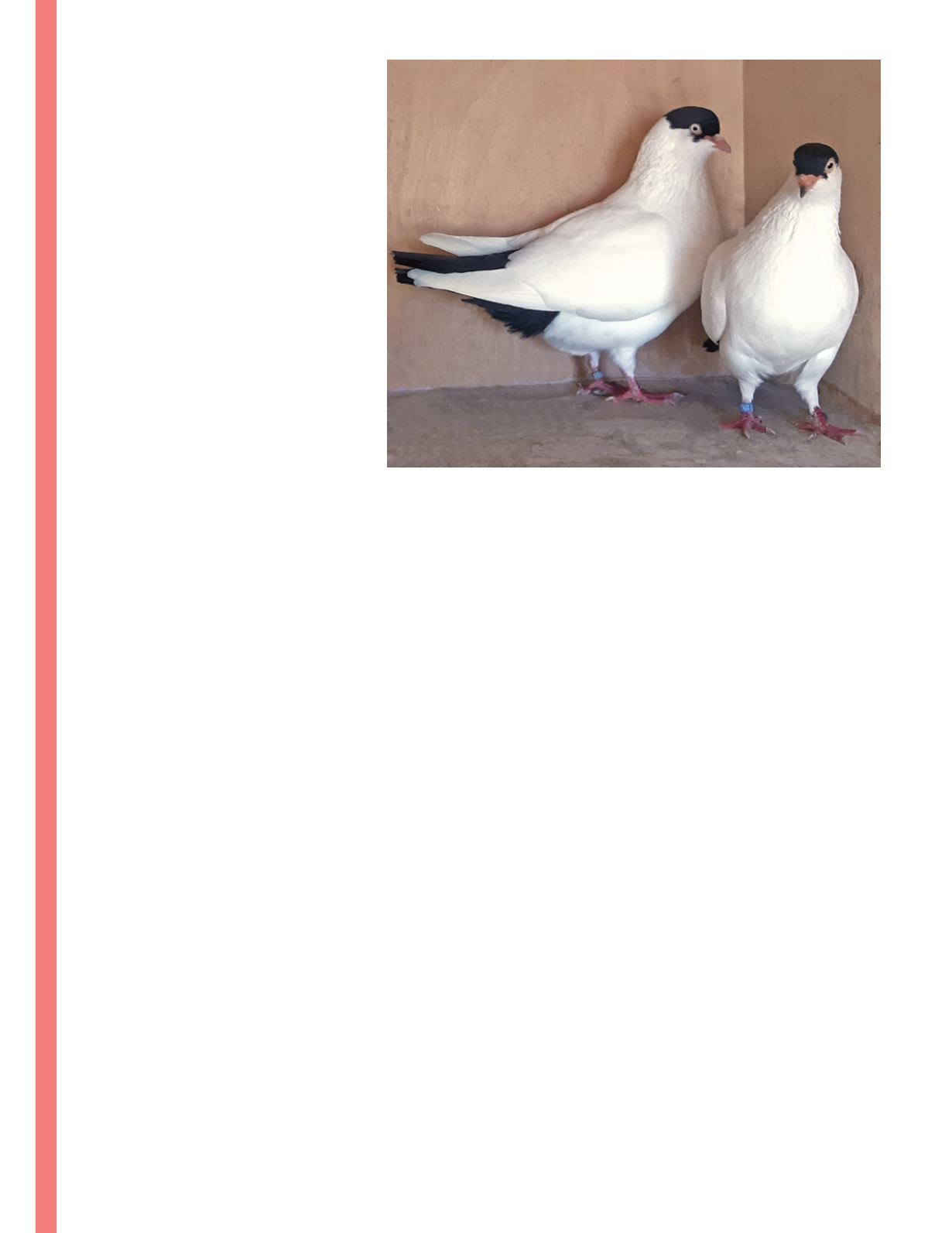
pletely white pigeon with only a colored Helmet/head and tail.
The marking of the Helmet starts from the corner of the beak in
a straight line, passing the bottom side of the eye via the back
side of the head to the corner of the beak at the other side. Its
colors are black, red, yellow and blue. The colors must be deep,
warm and shiny. The color of the tail must be identical to the
color of the head.
The Dutch Helmeted Pigeon is a pigeon that has to have
a strong built. It is a little bigger than the Dutch Highflyer and
a little smaller than the Hagenaar. It should be wide with a
good underpart, so that it is a powerful pigeon which shows its
flying capacity. There should be strong flight feathers. The body
should be horizontal with wings resting on top of the tail. The
standard describes: compact, powerful, wide, deep and rounded
breast and a horizontal position. The head must have an unin-
terrupted line without showing a forehead and well filled. The
beak must grow horizontally. The eyes must have a pearl color
with the smallest possible pupil. The edges around the eyes are
fine and thin, meat colored and well closed by the feathering.
The neck should be medium long and rise up deep from the
breast. The breast must be deep and well positioned to the front.
The back is wide within the shoulders, flat and a little down-
wards and well covered by the wings, especially on the tailbone
The wings must be wide and powerful with wide pens and such
a length that the wings are resting approximately 1 cm before
the end of the tail on the tail. The wings should not be crossed.
The tail is formed by 12 broad, medium-long feathers,
which as a whole, as they are carried flat and strictly together,
does not show too widely. The legs are medium long, colored
red and from the knee unfeathered. The nails should be white.
THE DUTCH HELMET LOVER – JAN DE WIT
As a young boy I got several fancy pigeons from my uncle
Kees Overdevest from Wassenaar. He was a small breeder of
Dutch High Flyers and Helmet pigeons. He was member of
the local club. I have a picture of myself where I hold my Old
Dutch meeuwtjes. I also had Welsummer bantam chickens and
rabbits. My mother enjoyed seeing that I have some farmers’
blood. My uncle Rinus de Wit was a very active rabbit breeder
of Vlaamse Reuzen and Rexen. I often visited exhibitions with
him all over Holland. I especially enjoyed watching the fancy
pigeons. I also had black Old Dutch Tumblers with a wild tail. I
was always attracted by the traditional old Dutch breeds. There
were many pedigree pigeon breeders in the neighborhood at that
time, amongst whom my uncle Dirk de Wit, our neighbors and
someone working at our company. I always wanted something
different from others and therefore I chose fancy pigeons. I
never started to breed them seriously.
During and after my school-time I started working abroad
at the customers of our company, to see how they treated our
tulip bulbs for forcing cut flowers. When I was 22 years old, I
started working in our family’s flower bulb company Jan de Wit
Zonen, (see our website
www.jandewitenzonen.com). I visited
our single customer in Japan together with my father for the
first time in 1987. Since then, we have quickly developed the
market over there and also in other Asian countries like China,
Taiwan, Vietnam and Russia. I travel abroad around three
months per year. That does not make it easy to breed pigeons.
Black plainhead Dutch Helmet