


 42 / 69

Helmet – Page 42 – Purebred PIGEON
Breed of the Issue - Helmet
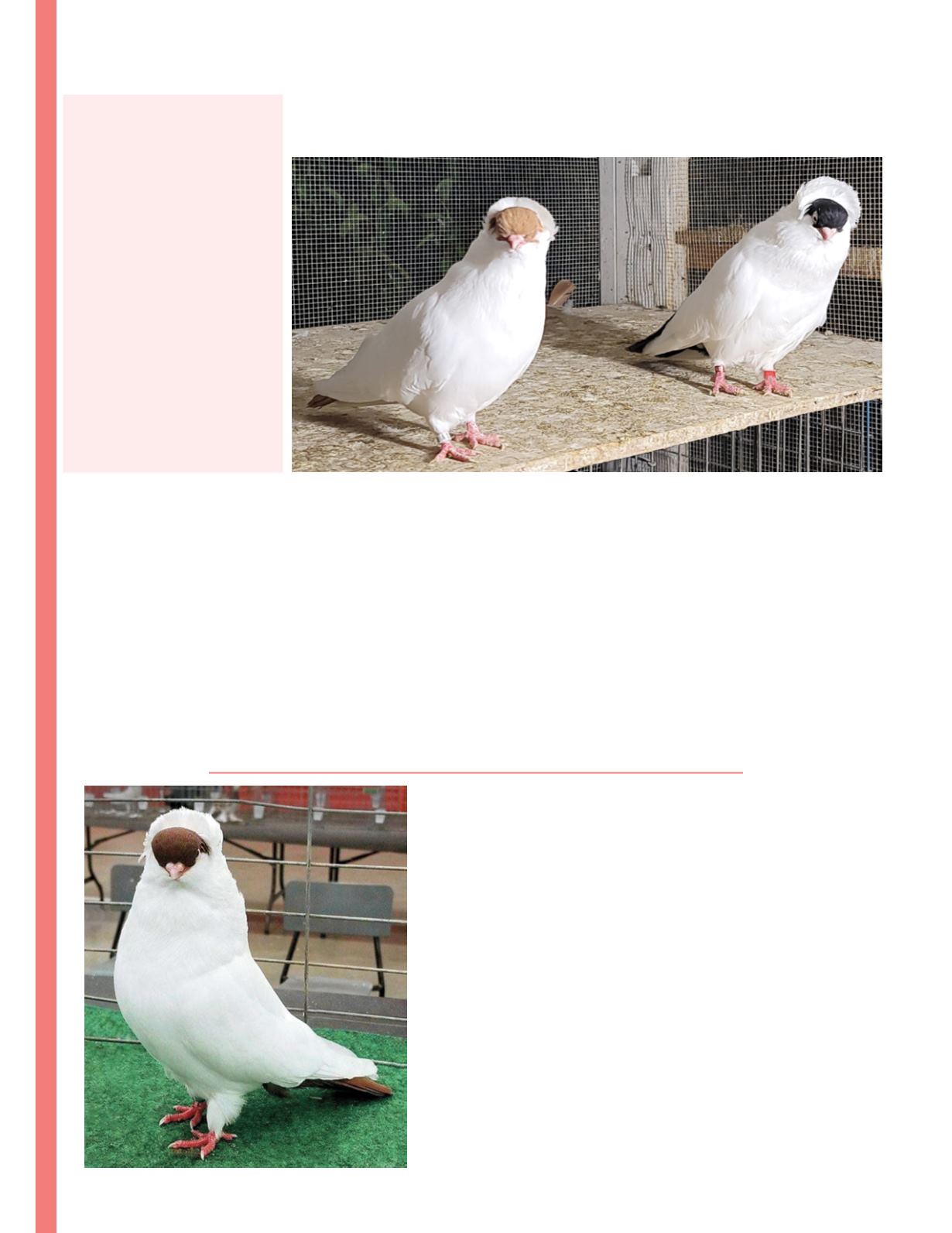
TYPE – 15 and 17 points.
Type should be proportioned in such a way as to present an evenly
balanced appearance in all respects. Should be sprightly in manner and
stand very erect, appearing to try to thrust its chest upward. The head
should be positioned so that the eyes are vertically in line with the balls of
the feet. Ideally, the bird should be on its front toes with its rear toes off the
surface.
Again, this is another characteristic that is so hard to consistently
have in your birds year in and year out. Lots of nice Helmets will never
be champions simply because they don’t have TYPE. The most common
fault in the Helmets regarding type are the Helmets that stand horizontal
or crouch. This is due mostly to the bad leg placement in our birds. Next
time you are out in the loft or at a show look at the Helmets with excellent
type and notice that the leg placement is up front under the chest. Birds with
improper leg placement will have there legs somewhere in the middle of the
wing shield. Type is paramount to have a champion Helmet. You can have a
weaker skulled bird win a big show but a Helmet that’s crouching and duck-
ing should not ever win no matter how big the skull or the crest is.
The standard says:
HEAD - Should be medium in size, with broad frontal, show-
ing no indication of flatness. The frontal should rise sharply
from the wattle with a well-defined forward curve, rising to a
full top skull (on the short faced varieties, the distance from
the eye to the frontal should be greater than from the eye to the
top skull), then flowing back to the base of the crest without
any breaks to mar it’s continuity. There should definitely be
more front than back skull. Top skull should not be lacking.
Viewed from the front, the face should start to develop right
behind the wattle with broad cheeks and rising with fullness
across the eyes, appearing slightly arched, instead of flat or
angular. Any indication of a narrow face or pinched appear-
ance should be avoided. Despite the desire for a broad full
frontal, “eyebrows” (feathers protruding over the eyes) must
be avoided. The crest should be the only interruption in the
smooth flow of the head into the neck.
The reason I put so much emphasis on the skull is that
I find this is the one feature that you can lose in one season.
In our ever-constant pursuit of big crests we sometimes use
weak skulled birds. And as per Murphy’s law it’s usually the
weak-headed birds that have tremendous crests. The weak
skulls take over and it takes years to get a loft full of Helmets
with broad frontals. My opinion is that the long skinny heads
are just a reversion back to the wild type so in the breeding
pen the broad skulls will lose out every time.
I
t is no surprise to many
when they ask me what I
consider the most important
features of the Helmet pigeon is,
I answer without hesitation: the
head/skull, type, beak set, size,
feather.
When we look at the
standard, we see that the head
only has 10 points allocated to
it for the crested variety and 12
points for the plainhead variety.
For this article we will only be
talking about the medium faced
Helmet although this discussion
can be and should be applied to
the short face variety of Helmet
as well.
Helmet Aspirations
By Pavel Lutsenko