



 10 / 20

10 – Purebred PIGEON
laid pairs of eggs in the boxes and dutifully took turns
incubating them, with the hen taking the longer shift
from late afternoon through the following morning and
the cock relieving her during the middle part of the day.
(Years later, I was surprised to learn that both parents
of very few animals, outside of most birds and humans,
share in the responsibility of child rearing.) Waiting for
the eggs to hatch seemed to be the longest 18 days of
my young life. Some 58 years later, it still is!
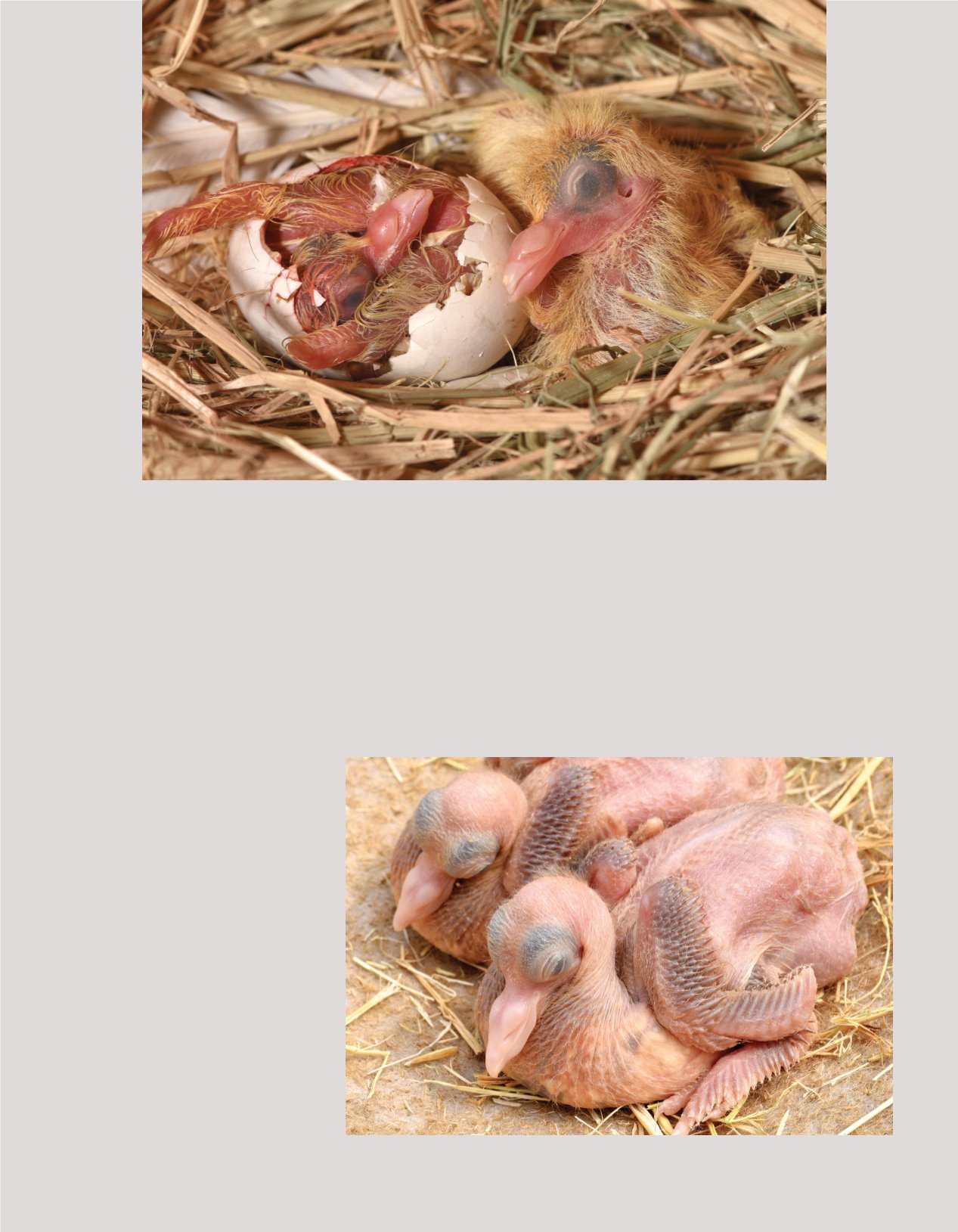
It is like magic – a miracle –
when the tiny, naked babies finally
appear under the hens. I still feel
excitement seeing the new hatch-
lings for the first time. So small and
seemingly fragile, it’s amazing that
they all aren’t crushed or able to find
food those first couple of days. And,
of course some don’t make it. But, a
little Darwin (over 200 million years
of evolutionary history, starting with
their earliest ancestors, various the-
ropod dinosaurs) and a lot of luck
goes a long way in helping baby
pigeons survive this most vulnerable
period of their lives.
A pair of baby pigeons, pestering and pleading to
their parents to be fed, is surely one of the cutest sights
in nature.
After the first week, the babies have become
pincushions of sprouting feathers. Every morning I lift
the hens up a little, hoping to see that both babies are
healthy (alive!) and their crops are bulging with food. I
anxiously wait for the feathers to open. It’s like watch-
Bernburg Trumpeters (black)
Eight-day old yellow Saxon Priests